interview with Ana Bragdon
How would you describe your overall training philosophy when working with cats?
The core of my philosophy is empowering the individual to meet their needs through a wide range of functional and acceptable behaviors – functional meaning that the behavior works for the individual to get the desired consequence, and acceptable meaning that it is acceptable in the social context they live in. (So, while scratching the furniture is functional for the cat in that it helps them stretch and visually mark their territory, most humans do not find it acceptable for the cat to scratch the furniture in their home.)
I take a constructional approach, which means that I help clients focus on what they actually want the cat to do, as opposed to what they want to stop. (For example: We want the cat to use their litter box – instead of – We want the cat to stop peeing outside of the litter box.) If the cat is doing something you don’t like, the most effective approach is to try to understand why the cat is doing the behavior – after all, it’s functional for them – and give them a more acceptable and easier way to get what they need.
I use the humane hierarchy as a guide, so we first make sure that the cat’s physical and behavioral needs are met – and any underlying medical issues are addressed – before we get into any behavior modification. Next, we look at ways to manage the environment to make the desired behavior easier. Then, we get into positive reinforcement, and then reinforcement of an alternative behavior. We do not apply punishment with cats.
Punishment is arguably not the most effective method of training with any species, but it is especially not appropriate for cats. Since cats are small animals, they are easily intimidated by humans, but that doesn’t help them learn. Cats don’t have a sense of right and wrong. They don’t obey for fear of punishment. Most likely, the cat will either run away, shut down (learned helplessness), or fight back (defensive aggression).
Training is not about obedience. Training with another living being is all about building a relationship – little by little, over time. Notice I said training with. Especially when it comes to cooperative care, training is a dialogue. You’re not just teaching the cat; you’re responding to their communication. You’re learning together.
What do you consider the biggest challenges when training cats compared to other species?
Honestly, the biggest challenge has to do with our cultural expectations surrounding cats.
One of the things we love most about cats is their independent nature. Anyone who identifies as a cat person will tell you – You can’t make a cat do anything!
In many ways, cats are more independent than dogs – or it seems that way because they fit into our lifestyle more conveniently. That leads to the (widespread) misconception that they are low-maintenance pets. But cats aren’t just decorative features. We sometimes forget that cats are living creatures with their own individual feelings and needs.
Some folks are still holding onto old-fashioned ideas. They expect cats to be self-sufficient, but allow them to pet and cuddle them whenever they want. To them, the suggestion of having a relationship with the cat is preposterous.
If they’ve had cats for years, but the cat they have now is different from what they expected, they might think there’s something wrong with them. If they label their cat as naughty, spiteful, stubborn, aloof, aggressive, mean, or even semi-feral, they’re going to have a hard time seeing the complete picture of what’s happening and why. If a client comes in with the attitude that their cat is malfunctioning and needs to be fixed, they may not be open to suggestions that involve changing their own behavior. Often, changing a cat’s behavior starts with a shift in perspective for the humans.
How do you maintain motivation in cats during training sessions?
Cats have small stomachs and short attention spans. They learn best in short sessions of 3-5 minutes, initially. Short training sessions work well for me because behavior happens in seconds. In my experience, things don’t always go to plan. Short sessions allow me to reflect on what worked well and what I want to do in our next session. If I realize that I made a mistake or did something that wasn’t ideal, I can adjust more easily (and with less guilt) than if I had been working for 20 minutes.
If you want to keep a cat engaged in longer sessions, train often – daily, when possible – and make the training fun and easy (both for you and the cat)! That reinforcement history and the relationship you’re building with the cat will make it so they don’t want to stop training. You might even need a session ending routine, so the cats don’t get frustrated when training is over.
If you’re doing more difficult work, such as cooperative care procedures, work in breaks and fun behaviors that the cat enjoys. Make sure to give the cat a choice of whether or not to opt in. (It should be a true choice, so they still get equal reinforcement if they say no.) It’s important that they aren’t pressured into doing something they are uncomfortable with. You might think the cat would opt out all the time, but if you build the behavior gradually, always staying at a level that’s not too stressful for them (called staying under threshold), they will want to participate because they trust you and they enjoy working with you.
What types of reinforcers (primary vs. secondary) have you found most effective?
Different reinforcers have their uses, depending on the context. (Personally, I don’t find the technical distinction between primary and secondary reinforcers OR classical and operant conditioning to be all that useful.)
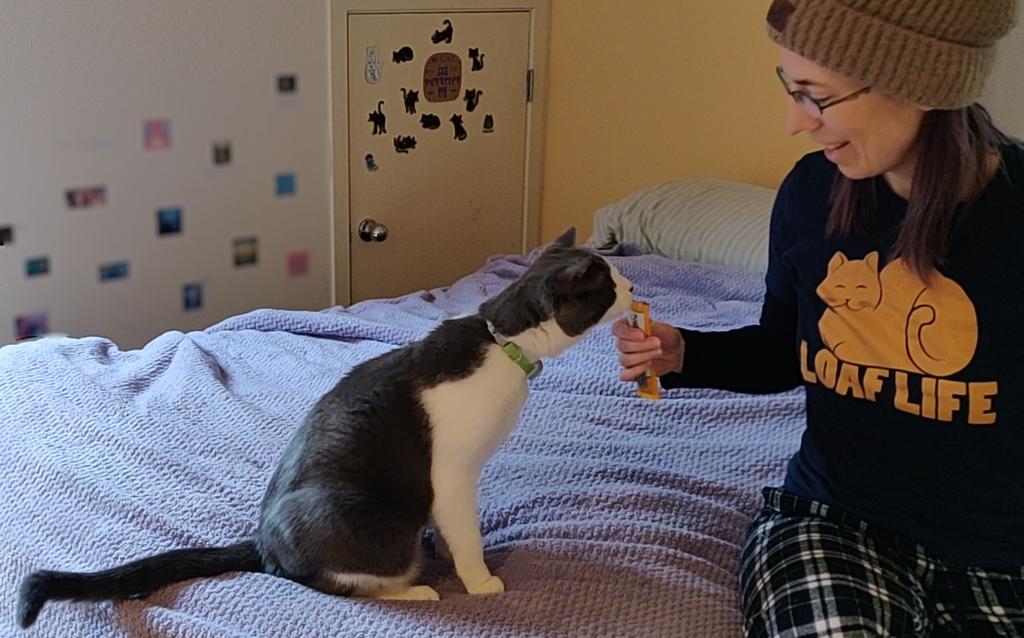
Food is the easiest to use. I like to use a click (either a tongue click or the sound of a clicker) as a marker when I can’t deliver food immediately. A clicker is an example of a secondary reinforcer. When it’s used often and consistently paired with a treat, the sound of the click gets associated with good things. Then, the click itself becomes reinforcing. You can use the click as a marker anytime you want enthusiasm and excited energy during training (typically not for calm low-energy training).
It’s important to continue to follow the click with a treat, so it retains its predictive power. Phase out the clicker when you’re working on well-established behaviors. Then, you can vary the reinforcers used. Don’t stop reinforcing the desired behavior altogether! (Think of it like this: Would you continue to work if your boss stopped paying you?) If you’re concerned about your cat getting fat from all those treats, you can cut back a little on their regular food to compensate.
I sometimes hear people say that their cat is not food-motivated. It’s an odd thing to say, because food is essential to life. I think it’s more appropriate to say that the cat is not excited about food during training. In that case, we need to look at why, especially if it’s a recent change. It could be that the cat isn’t feeling well, or they just ate, or it might have to do with the type of food offered, or how it’s presented. Maybe the cat is undersocialized, so they’re nervous around people. (In that case, we don’t want to use food to try to lure them into an uncomfortable situation because that will be stressful, not reinforcing, for them.) If all of those things have been considered, we can recognize that the food may not be an effective reinforcer for the cat in this context. Some of us live to eat, while others eat to live. But it’s important not to make that assumption just because we tried one kind of treat in one situation and the cat wasn’t interested. We could be giving up what is potentially a very powerful reinforcer.
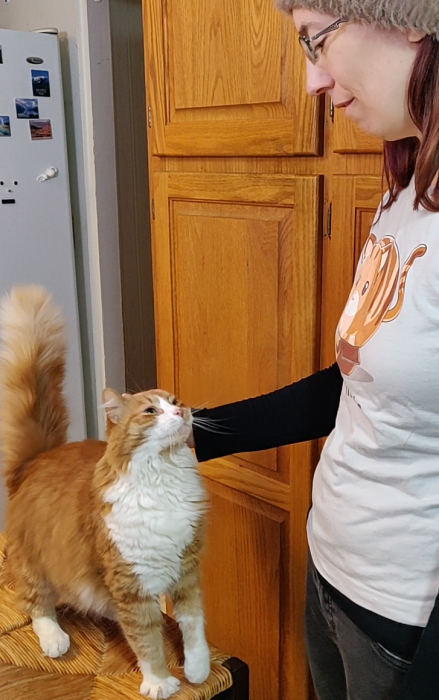
Fortunately, reinforcers aren’t limited to food. If a cat isn’t excited about food during training, we can use tactile reinforcers: petting or brushing in a way the cat enjoys. It’s important to respect the cat’s body language, and allow them to initiate and opt out of interactions as they please.
Play can also be used as a reinforcer. Play is harder to use because the energy is out of control. I like to use play as a celebration at the end of a training session, and for mini breaks during more difficult, focused training.
I sometimes hear people say that their cat doesn’t play. One of the functions of play is that it simulates hunting for cats. Hunting is in a cat’s nature. It’s essential to their quality of life. Saying a cat doesn’t play is like saying a cheetah doesn’t run, or a falcon doesn’t fly.
When I hear people say their cat doesn’t play, I want to know more. It could be that the cat has a mobility issue, or the cat is uncomfortable or in pain. It could have to do with timing, the type of toy, how it’s moved, the person’s level of engagement, even competition with other cats.
Every cat plays in some way. We just need to find what works for that individual. A senior cat might be less energetic than a kitten, a 3-legged cat might not climb as much, a blind cat might prefer toys that make noise, and a deaf cat might pay more attention to the toy’s movement and texture, but every cat needs to play.
In some cases, cats will work for attention and verbal praise, but these are harder to use consistently. The trainer can get in the habit of talking too much, which is distracting for the cat. Sometimes, cues and praise are melded together, which makes the cues unclear. (An example would be “Sit pretty. Good ‘sit pretty.’ You’re such a good kitty!”)
How does feline biology and psychology impact how you structure training sessions?
The natural history of cats informs us on what types of behaviors are natural for them. We’re more likely to be successful training the cat to do something that comes naturally – like jumping up onto a chair – than something that goes against their nature – like using a toilet. It also informs us about when they are active, how much they typically eat, and the kinds of things that are likely to be scary for them. We’re more likely to be successful with training when the cat is awake and starting to think about food (but not overwhelmingly hungry), and not putting them in a situation that’s likely to be scary for them.
Generally speaking, cats don’t find hugs comforting because, basically, we’re restraining them. It’s important that we give cats choice during training and activities, and never make them feel trapped. (This is one reason why I don’t favor using backpacks and strollers for cats, except for short transit times.) Avoid looming over the cat (like a predator), and resist the temptation to play under the covers or wrestle with the cat using your hands (like prey). Don’t expect a cat to train alongside a dog unless you know they have a good relationship, because dogs can be predators to cats, so many cats find them threatening.
Cats are solitary ambush hunters. They tend to do most of their learning individually, (although social learning can take place when cats have a close relationship). It’s easiest to train cats one-on-one, but that’s not always possible in multi-cat homes where the cats all want to participate in training, and they get frustrated when doors are closed. In that case, we can use chairs or folding step stools to create stations for each cat, so they all have their own personal space.
It’s important to consider the impact of socialization. Whether a cat grows up to be more curious or cautious depends on their genetics and early learning experiences. (The critical socialization period for cats is 2-7 weeks of age.) If a cat tends to be more cautious, we need to be especially patient, because it will take longer for them to come around to new experiences. That includes how they respond to people.
Cats who have not been well socialized to humans will need a different approach. A protocol that transitions from negative reinforcement – removing the scary human when they show any hint of the desired behavior – to positive reinforcement – adding treats or something else the cat enjoys – is often employed.
Can you think of a time when the environment significantly affected a cat’s training outcome? How did you improvise or personalize their training?
As behaviorists are fond of saying, behavior always happens in context. Therefore, the cat’s behavior and the environment are inextricably linked. Cats learn by association, and they don’t just pay attention to the cues you intentionally give; many of the cues come from the surroundings. (A cat might think “When the person calls my name in the kitchen, I can go to them and get treats.”) This explains why the cat might not perform a well-trained behavior in a different context. (The cat might not come if you call them in the bedroom, or they might not come when your friend calls their name.)
Be aware of distractions in the environment that might impact your training. You’re unlikely to be successful in training a new behavior if someone is cleaning the gutters on your roof overhead at the same time. (It’s noisy and will probably make the cat nervous!) If you’re working with multiple cats, one might eat treats faster and try to steal from the others. Working on elevated stations can help to address this.
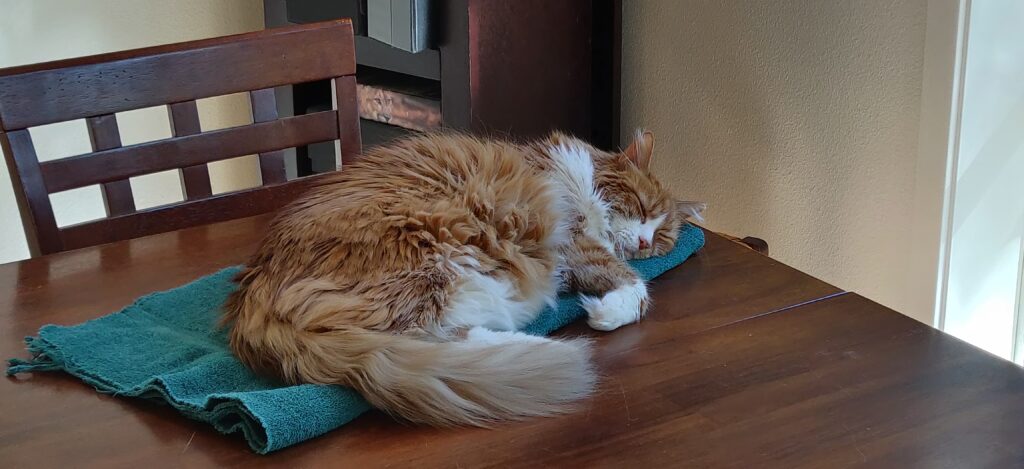
My cat Linus has a tendency to get overstimulated when he’s excited, or when he has had enough hands-on attention. He responds by swiping and biting. I wanted to teach him to calm down on cue. I observed that he would often lay on towels or sweaters if they were left on the floor, so I used that to teach him a relaxation routine. We trained in different areas and with different towels, so he was able to generalize that skill. Now, we can even use a towel to get him to lay down on the scale, so we can measure his weight.
What methods do you use when addressing undesirable behaviors in cats?
I love that you use the phrase “undesirable behaviors” rather than “inappropriate behaviors” because, from the cat’s perspective, their behavior is appropriate and makes sense.
I start by asking: Why are they doing it? As frustrating as it is, I remind clients not to take things personally. Cats don’t do things out of spite. The cat isn’t thinking about how their behavior will make you feel. The cat is just being a cat. So, what’s the function of the behavior?
Then: What is a more acceptable way for them to get what they need? How can I make the desired behavior easy, and the undesired behavior less convenient? This might involve arranging the environment to prevent the undesired behavior from happening – by blocking access, or changing the cues that lead up to the undesired behavior.
It’s worth mentioning again that I do not employ punishment with cats. That includes deterrents – things that are meant to be aversive and prevent cats from engaging in undesired behavior. This is because these things don’t address the cat’s underlying needs. Putting sticky strips on the armrests of the couch does not give the cat an appropriate outlet for the behavior of scratching. They will continue scratching the furniture if you do not provide a scratching post that meets their needs – one that the cat actually likes.
Why did you decide to specialize in cat training?
I have always had a soft spot for misunderstood animals. Growing up, we learned to interact with cats in a certain way – the way it was always done. When the cat jumped up on the table, we would spray him with water from a spray bottle, because we didn’t know any better. The cat jumped down, so we thought the punishment was working. (It didn’t stop him from jumping up on the table when we were looking the other way, and he would flinch noticeably anytime we reached for something, probably thinking we were going to spray him.)
Years later, when my husband and I adopted Linus, as a kitten, we tried to employ that same technique with the spray bottle when Linus jumped up on the table. But Linus reacted in a totally different way (unexpected to us)! He swiped at us when we used the spray bottle. I recognized it as defensive aggression. That’s when I realized that there had to be a better way of understanding and relating to cats.
Over the next few years, I read all the cat behavior books I could get my hands on. I decided that I wanted to help people and cats improve their relationships, through empathy and understanding. Now, I focus on creating educational content on YouTube and doing consultations.
What advice would you give someone who is interested in pursuing feline training or behavior work?
Don’t quit your day job! That’s kind of a joke.
Cat behavior consulting as an industry has grown tremendously in the past decade, but it is still in its early years. Cat training and cat behavior consulting aren’t yet mainstream. Most people haven’t recognized that cats benefit from training.
I’m not a competitive person. I think there are plenty of clients out there. They just haven’t realized that they need us! Rather than trying to outdo each other or put each other down, cat behavior consultants would do well to come together, support each other, refer clients, and promote each other’s content. We need to keep putting our voices out there, to reverse the tide of misinformation that people encounter online. That will make us look better than ranting about how popular expert So-And-So has got it all wrong!
Seek out cat-specific education, but don’t shy away from content geared towards dog trainers. Behavior is universal. Most concepts can be applied across species, with a few adaptations.
Volunteer or work with a cat rescue organization to get experience working with many different cats. If you work with a shelter, make sure you have a support system of people who are in your corner, and self-care strategies because burnout is a real problem. Try to find an organization that has a reputation for prioritizing the well-being of their team.
If you do find yourself in a toxic work environment, remember that you’re there to gain experience and to help some people and cats. You can’t be the hero for all of them. You won’t be able to help anyone if you push too hard and burn out. You don’t need to work there forever; get some experience and move on. Unless your passion is in improving organizational culture. In that case, carry on!
Cat behavior consulting can feel very isolating. It’s important to find a community to connect with for support, and to help you keep growing your skills and knowledge. Organizations like PPG, KPA, and IAABC can be a good place to start, or connect with people you meet at conferences (in person or online).